
Short answer: Hot tub health benefits are backed by real research. Regular hot water immersion is linked to better blood vessel function, lower blood pressure, easier sleep and faster muscle recovery. Pairing a hot tub with a cold plunge (contrast therapy) reduced muscle soreness more than rest in a review of 13 studies. Fall and winter are the best time to start: it's hot tub season.
Why is fall and winter "hot tub season"?
Ontario winters are long, dark and cold. Your body spends months tense against the weather, and most of us move less. A hot tub turns the coldest part of the year into the best part of your evening: steam rising, snow falling, 20 minutes in 38 to 40°C water.
It's also the best time to buy. Installing in the fall means you have the whole winter ahead of you, and the Gib-San Pool & Hot Tub Centre is open all year with hot tubs, swim spas, cold plunges and saunas on display to try in person.
Custom concrete spa or hydrotherapy hot tub: which is right for your home?
There's more than one way to bring hot tub season home, and Gib-San does both.
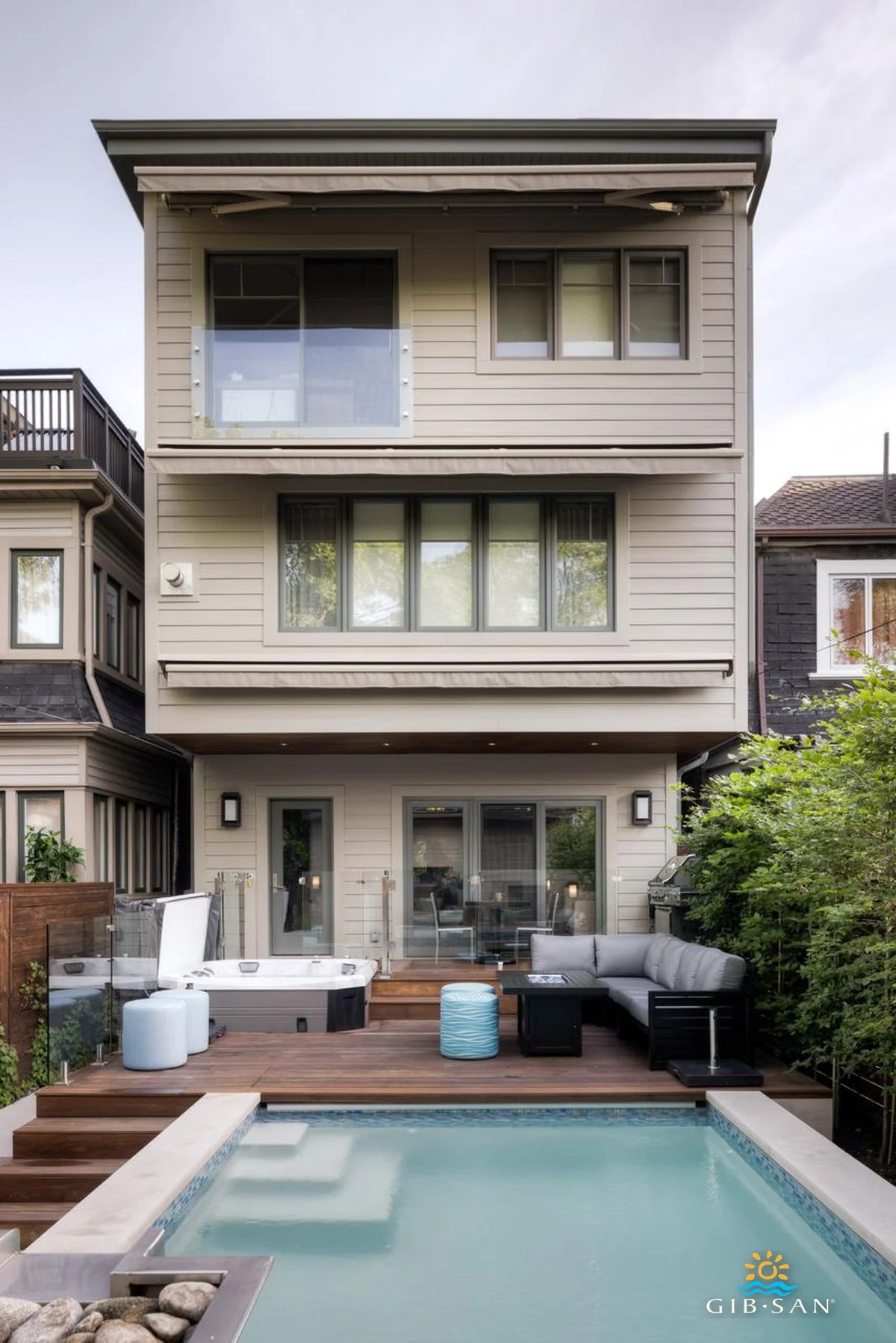
- Custom concrete hot tubs. Our design and construction team builds custom concrete spas to any shape and size: attached to a new pool with a spillover, raised as a stand-alone feature, or set flush into a stone terrace. Finishes, tile, lighting and jets are chosen to match your home, so the spa becomes part of the landscape.
- Pre-fabricated hydrotherapy hot tubs. Our Pool & Hot Tub Centre sells Marquis and Great Lakes Spas hot tubs, engineered for targeted hydrotherapy with sculpted seating and jets. They're a natural fit for city backyards: set one on a deck or patio, tuck it beside the house, and you're soaking far sooner than with a custom build.
Not sure which suits your yard, budget and timeline? Come sit in a few at 711 Kipling Avenue, or book a design consultation and we'll walk you through both.

Hot tub health benefits: what happens to your body?
When you sit in water warmer than your skin, three things happen at once:
- Heat. Your core temperature rises, your blood vessels widen, and your heart pumps more blood to your skin. Researchers describe these effects as similar in some ways to light exercise.
- Buoyancy. Water supports most of your body weight, taking load off your joints, spine and feet.
- Hydrostatic pressure and jets. The water gently presses on your whole body, and the jets massage specific muscles.

Is a hot tub good for your heart and blood pressure?
The research is promising. In a 2016 controlled study at the University of Oregon (Journal of Physiology), sedentary young adults soaked in 40.5°C water four to five times a week for eight weeks. Compared with a group in body-temperature water, the heat group showed:
- Better blood vessel function (flow-mediated dilation nearly doubled, from 5.6% to 10.9%)
- Less arterial stiffness
- Lower blood pressure (mean arterial pressure fell from 83 to 78 mmHg)
The researchers wrote that the changes were "on par or greater than" what's typically seen with exercise training in sedentary people.
A large Japanese study published in Heart (2020) followed more than 30,000 adults for about 20 years. People who soaked in a hot bath almost every day had a 28% lower risk of cardiovascular disease and a 26% lower risk of stroke than people who bathed twice a week or less. This was an observational study, so it shows a link, not proof of cause.
What this means for you: a hot tub is not a replacement for exercise or medical care, but a regular soak is one of the most enjoyable habits you can add to a healthy routine.
Can a hot tub help sore muscles and stiff joints?
Yes. Warm water relaxes muscles and increases blood flow, buoyancy takes the weight off sore joints, and targeted jets work into the neck, back, calves and feet. That's why physiotherapists and athletes have used hydrotherapy for decades.
For many people, a hot tub is also the easiest way to move. Gentle stretching in warm, buoyant water is far more comfortable on stiff hips and knees than stretching on the floor.
Does a hot tub before bed help you sleep?
It can. A 2019 review in Sleep Medicine Reviews (University of Texas at Austin) analysed 17 studies and found that bathing in water of about 40 to 43°C, ideally one to two hours before bed, improved sleep quality and helped people fall asleep about 10 minutes faster.
The reason is counterintuitive: the soak draws heat to your skin, and as you cool down afterward, your core temperature drops. That drop is one of your body's natural signals that it's time to sleep.
What is contrast therapy?
Contrast therapy means alternating hot and cold water: a few minutes in the hot tub, then a short dip in a cold plunge, repeated a few times. Athletes have used it for years, and it has become one of the most popular wellness routines for home.
What does the research say about hot and cold contrast therapy?
- Recovery: A 2013 meta-analysis in PLoS ONE pooled 13 studies on contrast water therapy after hard exercise. Contrast therapy reduced muscle soreness and strength loss compared with simply resting, at every time point measured from under 6 hours to 4 days.
- Cold-water response: In a 2000 study (European Journal of Applied Physiology), an hour in 14°C water raised levels of noradrenaline in the blood by 530%, part of the body's natural "wake-up" response to cold. You don't need anywhere near an hour; most people plunge for one to three minutes.
- Getting used to heat and cold: A 2021 University of Copenhagen study (Cell Reports Medicine) of experienced winter swimmers who alternated heat and cold found their bodies handled cold differently. Those participants averaged about 11 minutes of cold and 57 minutes of heat per week, spread across sessions. It's a small study, but a useful benchmark for a weekly routine.
How do I do contrast therapy at home?
A simple routine to start with:
- Hot tub: 10 to 15 minutes at 38 to 40°C.
- Cold plunge: 1 to 3 minutes at around 10 to 15°C. Breathe slowly; it gets easier.
- Repeat 2 to 3 rounds.
- Many people like to finish cold in the morning for energy, and finish warm in the evening to wind down.
Start gently, with shorter cold dips and slightly warmer cold water, and build up over a few weeks.
Is a hot tub safe for everyone?
Hot tubs are safe for most healthy adults when used sensibly. Follow these guidelines from the US Consumer Product Safety Commission and the CDC:
- Keep the water at 40°C (104°F) or below.
- At 40°C, keep soaks to about 15 to 20 minutes.
- Skip alcohol before and during a soak.
- Pregnant women, young children, and anyone with heart disease, blood pressure concerns or other medical conditions should talk to their doctor first. The same applies to cold plunges.
- Keep a locked safety cover on when the tub isn't in use.
Why GTA homeowners trust Gib-San
- Try before you buy. Our Pool & Hot Tub Centre at 711 Kipling Avenue in Etobicoke is open year-round, with hot tubs, swim spas, cold plunges and saunas on display. Sit in them, compare seats and jets, and find the right fit.
- Brands we stand behind. We carry Marquis hot tubs, refined over forty years in Independence, Oregon, and Great Lakes Spas.
- Custom concrete spas and contrast setups. Our design team builds custom concrete hot tubs, and can pair a spa with a cold plunge or design both into your landscape.
- Support for the life of your hot tub. In-store water testing, Gib-San water care made in Ontario, filters, accessories and service, all from one family team that has cared for backyards since 1973.
Want the bigger picture? Read 7 Life-Changing Health Benefits of Hot Tubs and Hydrotherapy, our guide to hot tubs for your mind, and our hot tub maintenance guide.
It's hot tub season. Visit the Gib-San Pool & Hot Tub Centre at 711 Kipling Avenue, Etobicoke, call 416.231.9699, or email retail@gsplc.ca to book a test soak.
This article is for general information and is not medical advice. Talk to your doctor before starting hot or cold water therapy, especially if you are pregnant or have a medical condition.
Questions people ask
How long should I stay in a hot tub?
At 40°C (104°F), about 15 to 20 minutes is a good guideline for healthy adults. If you want a longer soak, lower the temperature a few degrees.
What temperature should my hot tub be?
Most people enjoy 37 to 40°C (99 to 104°F). Never go above 40°C.
How long should I stay in a cold plunge?
One to three minutes at 10 to 15°C is a common starting point. Start shorter and build up gradually.
Is it better to finish hot or cold?
It's personal preference. Many people finish cold in the morning for an energizing feel, and finish warm in the evening to help them relax before bed.
When is the best time to buy a hot tub in Ontario?
Fall. Installing before winter means you get the full hot tub season, the time of year you'll use it most.